
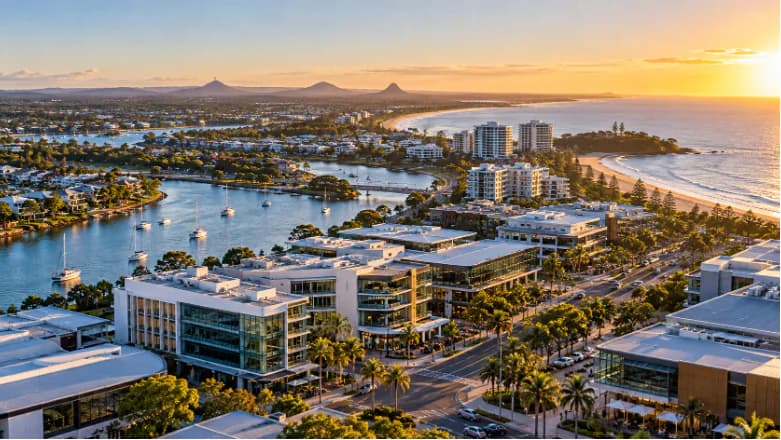

Commercial Property Buyer's Agent Sunshine Coast
Explore the Sunshine Coast commercial property market and learn how professional research, due diligence and buyer representation can support an acquisition.
The Sunshine Coast has traditionally been associated with beaches, tourism, residential property and lifestyle migration. While these remain important, they no longer tell the full story of the local economy. Population growth, infrastructure investment, healthcare expansion, new commercial precincts and a broader employment base are steadily changing the region's commercial property landscape.
For investors and business owners, opportunities now extend across industrial premises, warehouses, offices, retail properties, medical-related facilities and other business accommodation. But a growing region doesn't automatically make every commercial property a strong investment. Commercial real estate requires a different level of analysis from residential property — the building matters, but so do the tenant, lease, location, permitted use, outgoings, surrounding businesses and future supply.
This is why buyers need to understand not only how the Sunshine Coast is growing, but how that growth translates into demand for specific types of commercial property.
A Larger, More Diverse Commercial Economy
Sunshine Coast Council forecasts indicate the region could grow to around 565,700 residents by 2046 — a substantial increase in demand for employment, healthcare, shopping, professional services, logistics, education and everyday business services. Every additional household creates economic activity beyond the residential market, and the businesses serving that activity need suitable commercial premises.
The economy is also diversifying. Tourism remains important, but healthcare has expanded significantly, particularly around Birtinya and the Sunshine Coast University Hospital precinct. Education, professional services, construction, technology, manufacturing and other industries now contribute meaningfully to regional employment.
Maroochydore offers the clearest example of this shift, with development of the Maroochydore City Centre creating a modern precinct intended to accommodate businesses, offices, technology and employment. Infrastructure improvements — the expansion of Sunshine Coast Airport, transport investment and the international submarine broadband cable — have further strengthened the region's connections to national and international markets.
These developments matter because commercial property is ultimately supported by economic activity: businesses need premises when they expand, population growth creates customers, and infrastructure improves the usefulness of particular locations.
However, investors should be careful about assuming regional growth guarantees individual property performance. Commercial markets can be highly localised — a warehouse near transport connections may see very different demand from one in a less accessible industrial area, and offices near an emerging employment centre can have different prospects from those where businesses are moving away. The Sunshine Coast is better understood as a collection of distinct commercial precincts — Maroochydore, Kawana, Birtinya, Caloundra and others — each with its own economic drivers, rather than one uniform market.
A commercial property buyer's agent can help interpret these local conditions and compare properties against the buyer's objectives, rather than simply what's currently advertised.
Choosing Between Industrial, Office and Retail Property
One of the first decisions a commercial buyer needs to make is what type of property suits their objectives.
Industrial property has attracted considerable attention as population growth, construction activity, logistics requirements and expanding local businesses support demand for warehouses, workshops and industrial units. Vehicle access, loading areas, ceiling height, parking, power capacity and proximity to major roads all influence which businesses can occupy a property. A flexible building suited to several uses carries a different risk profile than highly specialised premises appealing to a narrow tenant group.
Office property faces a similar dynamic. As the local economy expands, professional, health, financial, technology and service businesses require accommodation — but modern demand is changing as flexible working arrangements make businesses more selective. Accessibility, parking, natural light, building quality and nearby amenities all influence whether an office competes successfully for tenants.
Retail property is different again. Population growth can support increased retail expenditure, but location remains critical — visibility, pedestrian activity, surrounding demographics, parking and nearby businesses all shape how well a retailer trades from a given site.
The tenant is central to any commercial investment. A reliable tenant on appropriate lease terms offers greater income visibility than a vacant property, but buyers shouldn't rely on current rent alone. The remaining lease period, rent review provisions, options, responsibility for outgoings and the likelihood of the tenant staying beyond the current term all need to be understood — along with how easily the premises could be re-leased if the tenant left. Vacancy can be expensive, since mortgage repayments, rates and insurance continue while rental income stops.
This is one reason buyers should weigh a building's underlying flexibility, not just its current tenant — a property suited to several different businesses often offers more resilience than one configured for a highly specialised purpose. Monopoly Wealth Property Buyers works across industrial, retail and office property, helping buyers compare opportunities before committing to a particular asset type.
Why Research and Due Diligence Matter
Commercial property is often marketed around yield, but yield alone is an incomplete measure. Two properties with similar advertised returns can carry very different risk — one with a strong tenant, years remaining on the lease and a versatile building in a growing location; another with a lease nearing expiry, significant maintenance needs and limited alternative uses. On paper the numbers might look alike; in practice, they can be very different investments.
Due diligence should cover lease documentation, building condition, zoning, planning restrictions, outgoings, current rental arrangements and surrounding development, often involving legal, financial, planning and building professionals.
Zoning deserves particular attention for owner-occupiers — a building may look ideal for a business without holding approval for the intended activity, so confirming permitted uses before committing can prevent costly problems. Future development also matters: as the Sunshine Coast prepares for major population growth, planning changes and new construction will create opportunities but could also add competing commercial supply, so understanding what might be built nearby is important for any office, warehouse or retail purchase.
Price analysis is similarly important. Comparable sales provide useful context, but commercial properties can be harder to compare than residential homes, since lease structures, tenant quality, building configuration and land characteristics all affect value. This is where independent buyer representation is valuable — the selling agent represents the vendor, while a commercial buyer's agent represents the purchaser and approaches research and negotiation from the opposite side. Monopoly Wealth Property Buyers assists with market analysis, property identification, assessment, negotiation and acquisition, offering local insight for buyers unfamiliar with the Sunshine Coast market.
Buying With a Long-Term Strategy
The most important consideration when buying commercial property on the Sunshine Coast is understanding why the property belongs in the buyer's broader strategy. For investors, this may mean income, capital growth, diversification or some combination. For a business owner, it may mean controlling premises, avoiding rental uncertainty and securing a location that can accommodate future growth.
Those objectives should shape every stage of the search. A buyer focused on reliable income may assess tenant strength and lease duration differently from an investor willing to accept some vacancy while repositioning a property, and an owner-occupier may weight operational suitability above immediate yield.
Professional buyer representation helps maintain that discipline. It's easy to become enthusiastic about a property once inspections and negotiations begin — having established purchasing criteria makes it easier to compare an opportunity against the original objective, and easier to walk away when the numbers, due diligence or conditions don't stack up.
The Sunshine Coast has strong long-term fundamentals: a rising population, expanding infrastructure and a diversifying economy, all contributing to an increasingly sophisticated commercial property market. But successful investment isn't simply about buying into a growing region — it's about identifying the right asset, in the right location, for the right purpose, at a price that reflects its risks and potential.
For investors and business owners considering commercial property on the Sunshine Coast, Monopoly Wealth Property Buyers can assist with research, property selection, due diligence coordination and negotiation from the buyer's perspective. To discuss how professional buyer representation could support your next acquisition, contact Monopoly Wealth Property Buyers at https://monopolywealth.com.au/.