
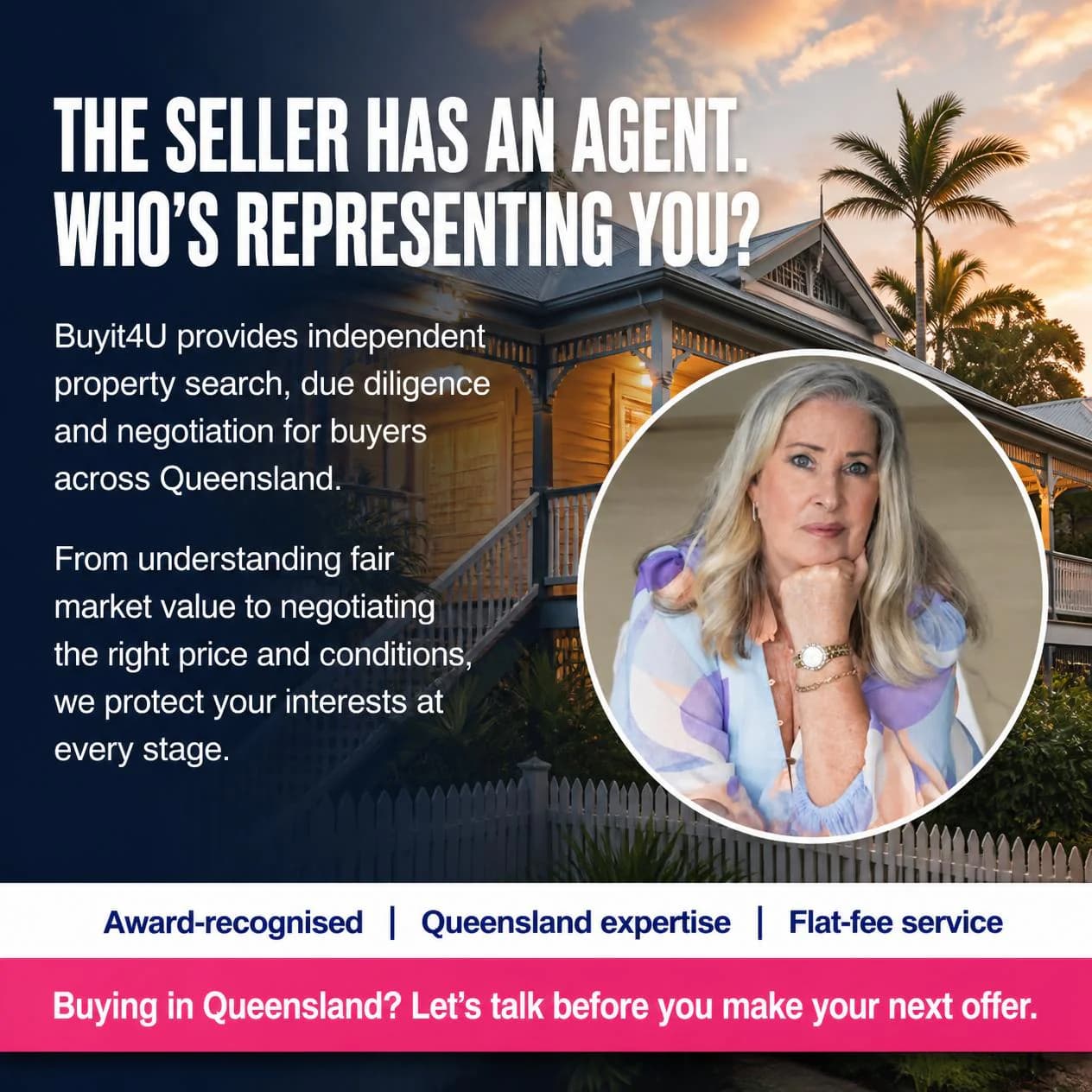

When you walk into an open home, it can feel as though the selling agent is there to help everyone.
They answer your questions, provide information about the property and guide you through the offer process. A good selling agent will always behave professionally and treat buyers fairly—but it is important to understand one fundamental fact:
The selling agent has been appointed by the vendor. Their role is to protect the seller’s interests and achieve the best possible outcome for them.
So, who is protecting yours?
The Queensland market is changing—but it is not standing still
Queensland remains one of Australia’s most closely watched property markets. Continued population growth, interstate migration, employment opportunities and the lifestyle offered across Brisbane, the Gold Coast and regional Queensland continue to support housing demand.
According to the latest available Australian Bureau of Statistics figures, Queensland gained more than 16,500 people through net interstate migration in the year to December 2025, in addition to more than 54,000 through net overseas migration. That continued population growth places ongoing pressure on established housing markets. (ABS population data)
At the same time, higher borrowing costs and affordability pressures are changing buyer behaviour. Some properties remain highly competitive, while others are taking longer to sell. Some suburbs continue to record growth, while others are becoming more price-sensitive.
There is no single “Queensland market”. There are hundreds of smaller markets, each moving according to local supply, buyer demand, property type, price point and location.
That is precisely why buyers cannot rely solely on headlines, online estimates or the price expectations communicated by a selling agent.
The selling agent does not represent the buyer
This is not a criticism of selling agents. It is simply an explanation of their role.
The selling agent is engaged and paid by the vendor. Their job is to:
- present the property in its best possible light
- create buyer interest and competition
- negotiate the highest possible price
- secure conditions that suit the vendor
- protect the vendor’s position throughout the transaction.
The Queensland Government itself explains that real estate agents commonly represent sellers, while buyers may separately appoint a buyer’s agent to find properties, undertake background research and negotiate on their behalf. (Queensland Government buyer’s agent guidance)
A selling agent may be warm, helpful and responsive—but that does not make them your representative.
If an agent tells you, “The vendor needs this price to buy their next home,” or “The seller won’t accept less because they need to clear their debt,” that information may explain the vendor’s position. It does not establish the property’s market value.
As a buyer, you are not responsible for funding the vendor’s next move. Your responsibility is to make a well-researched decision and pay a price supported by the property, the evidence and your own financial position.
Buying a property is not simply about finding one you like
Finding the property is often the easy part.
The difficult questions come afterwards:
- Is the asking price supported by comparable sales?
- Are the comparables genuinely similar?
- Is buyer competition real, or is it being used to create urgency?
- Has the property been correctly priced for its condition, location and risks?
- Are there flood, insurance, body corporate, planning or building concerns?
- What offer conditions should be included?
- How much competition is there—and how much should you reveal?
- When should you increase your offer, and when should you walk away?
Emotion can make these decisions incredibly difficult. Once a buyer pictures their furniture in the living room or imagines their family living there, it becomes much easier to rationalise paying more.
A buyer’s agent provides the independent voice in the transaction—the person able to step back, analyse the evidence and protect the buyer from making a costly emotional decision.
Protection does not mean simply negotiating a lower price
A strong buyer’s agent is not there to make a low offer on every property.
The objective is to secure the right property, at a fair market price, with conditions that appropriately protect the buyer.
In a competitive Queensland market, the winning offer is not always the highest offer. Settlement flexibility, deposit structure, finance timeframes, building and pest arrangements and the certainty presented to the vendor can all influence the result.
The role of a buyer’s agent may include:
- developing a clear acquisition strategy
- identifying suitable suburbs and property types
- reviewing comparable sales
- inspecting or assessing properties objectively
- recognising issues that require further investigation
- coordinating independent due diligence
- communicating with selling agents
- assessing the strength of competing interest
- structuring and negotiating the offer
- keeping the buyer informed from search through to settlement.
At Buyit4U, we do not recommend removing essential protections simply to make an offer look more attractive. Building and pest inspections, finance, valuation and appropriate legal advice can be critical. Winning the property means very little if the buyer inherits an expensive problem.
Information is not the same as independent advice
Buyers now have access to more property information than ever before. Online portals provide automated estimates, suburb medians and sales histories at the click of a button.
But more information does not necessarily create better decisions.
Online estimates are generated by algorithms. They do not walk through the property, assess the quality of renovations, understand the position of the block, smell moisture, notice poor workmanship or identify that the “comparable” sale had a substantially better outlook.
Similarly, a suburb median cannot tell you what one particular property is worth.
Property data needs interpretation. It must be considered alongside the property’s condition, land, layout, location, market competition and the circumstances of recent sales.
A buyer’s agent helps turn information into a strategy.
Trust must be earned
Trusting a buyer’s agent is paramount—but that trust should never be blind.
Your buyer’s agent should be appropriately licensed, transparent about their fees, clear about the services they provide and willing to explain the reasoning behind their recommendations.
They should be prepared to tell you when a property is worth pursuing—but also when it is overpriced, unsuitable or carries risks that outweigh its benefits.
Sometimes protecting a buyer means securing the property.
Sometimes it means negotiating harder.
And sometimes it means having the courage to say, “This is not the right one. Let’s walk away.”
At Buyit4U, we work on a transparent flat-fee basis, regardless of the property’s purchase price. Our interests are not tied to encouraging a buyer to spend more. Our role is to research, question, negotiate and advocate for the person who appointed us: the buyer.
Before you make your next offer, ask one question
When the seller has an experienced professional managing the campaign, creating competition and negotiating for their best outcome, ask yourself:
Who is doing the same for me?
Buying a home or investment property is one of the largest financial decisions most people will ever make. Buyers deserve their own representation, their own strategy and someone firmly positioned on their side of the negotiation.
The selling agent protects the vendor.
A buyer’s agent protects the buyer.
And in a complex, competitive and constantly changing Queensland property market, that distinction matters.
If you are considering buying in South-East Queensland—or investing elsewhere across Queensland—Buyit4U can help you understand the market, assess the property and negotiate from a position of knowledge rather than emotion. Contact Stacey and the Buyit4U team for a confidential conversation about your buying plans.